




Hi there! How can we help you today?
Top 5 Industrial Automation Trends in 2026|Dhyami Industrial Solutions
-
Home
-
Industrial Insights
-
Top 5 Industrial Automation Trends Shaping Manufacturing in 2026

Top 5 Industrial Automation Trends Shaping Manufacturing in 2026
A look at the top automation and control system trends transforming manufacturing plants — from smart sensors to predictive maintenance and energy-efficient drives.
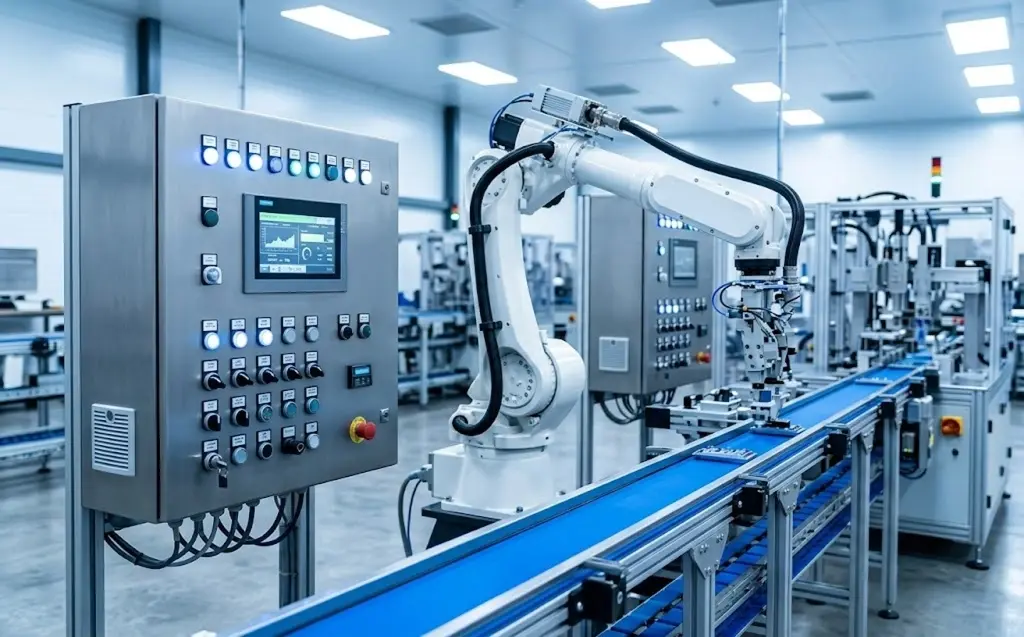
🤖 Top 5 Industrial Automation Trends Shaping Manufacturing in 2026
Manufacturing plants today face constant pressure to do more with less — less downtime, less energy waste, less manual intervention, and fewer surprises on the shop floor. Automation has always been part of that answer, but the technology behind it keeps evolving. What used to mean a basic PLC controlling a conveyor line has grown into interconnected systems that sense, predict, and adjust in real time. Here are five automation trends that are genuinely changing how plants operate this year, and what they mean for teams planning upgrades or new installations.
1️⃣ Predictive Maintenance Over Scheduled Maintenance
Traditional maintenance schedules assume every machine wears out at roughly the same rate, which means parts often get replaced too early — wasting money — or too late — causing failure. Predictive maintenance flips this model by using sensor data on vibration, temperature, and current draw to estimate actual remaining equipment life. Instead of servicing a motor every three months regardless of condition, plants are increasingly servicing it exactly when the data shows it's needed, cutting both unnecessary maintenance cost and unplanned downtime at the same time.
What's changed recently is accessibility. Sensor and analytics packages that used to require large capital investment are now available at a scale that fits mid-sized plants, not just large enterprises, making predictive maintenance a realistic upgrade path rather than a distant goal.
2️⃣ Smart Sensors Embedded Throughout the Process
Sensors used to sit at a handful of critical checkpoints in a plant. Now, IP-rated proximity sensors, photoelectric sensors, and pressure transmitters are being distributed much more densely across production lines, feeding continuous data back to control systems rather than isolated readings taken during manual inspection rounds. This density of data allows control systems to catch subtle process drift — a slowly rising pressure, a slightly slower cycle time — long before it becomes a quality issue or a breakdown.
3️⃣ Energy-Efficient VFDs Becoming Standard, Not Optional
Variable frequency drives have been available for decades, but their adoption used to be limited to applications where the energy savings clearly justified the upfront cost. That calculation has shifted. Rising energy costs combined with falling VFD prices mean that even applications with moderate variable-load demand — pumps, fans, compressors — now see a fast payback period from switching to VFD-controlled motors instead of running them at fixed speed. Plants are also increasingly specifying VFDs as a default part of new installations rather than an add-on considered later.
4️⃣ Centralized Control Through Upgraded PLC and SCADA Systems
Older plants often run multiple standalone control panels with little connection between them, forcing operators to physically move between stations to monitor different parts of a process. Modern PLC panels increasingly integrate with centralized SCADA dashboards, giving plant managers a single view of the entire operation — flow rates, motor status, valve positions, alarm history — all in one place. This consolidation doesn't just improve convenience; it significantly reduces the time it takes to diagnose a problem when something does go wrong, since operators aren't piecing together information from multiple disconnected systems.
5️⃣ Modular Automation for Faster Scaling
Rather than building a single large, custom-engineered automation system that's expensive and slow to modify later, more plants are adopting modular automation components — standardized PLC racks, pre-configured sensor packages, and skid-mounted control panels that can be added or reconfigured as production needs change. This approach trades a small amount of theoretical efficiency for a large gain in flexibility, which matters more than ever for plants that need to adjust production lines quickly in response to changing demand.
💡 Quick Tip: Before investing in new automation technology, audit which existing equipment already has sensor-ready capability — often, meaningful upgrades can start with software and control panel changes rather than a full hardware overhaul.
What This Means for Plant Managers ✅
- ☑️ Predictive maintenance reduces both downtime and unnecessary part replacement
- ☑️ Denser sensor networks catch process drift earlier
- ☑️ VFDs now pay back faster across more applications, not just high-load ones
- ☑️ Centralized SCADA speeds up diagnosis and reduces operator workload
- ☑️ Modular automation supports faster scaling as production needs shift
Planning an automation upgrade for your facility? Dhyami Industrial Solutions supplies PLC panels, VFDs, sensors, and complete automation systems engineered for real-world plant conditions.
Tags:
industrial automation manufacturing trends PLC systems predictive maintenance smart sensors energy efficiency VFD technology industry 4.0 Dhyami Industrial SolutionsShare this post: