




Hi there! How can we help you today?
Centrifugal vs Submersible Pump Comparison | Dhyami Industrial Solutions
-
Home
-
Product Guides
-
Centrifugal vs Submersible Pump: Which One Fits Your Application?

Centrifugal vs Submersible Pump: Which One Fits Your Application?
A detailed comparison of centrifugal and submersible pumps — working principle, use cases, pros, cons, and how to pick the right one for your fluid handling system.
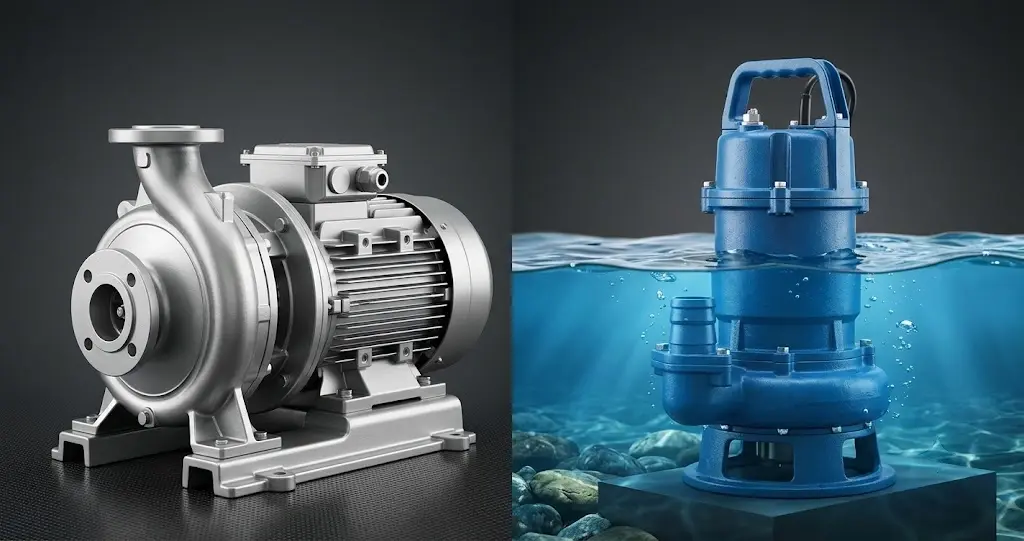
💧 Centrifugal vs Submersible Pump: Which One Fits Your Application?
Pumps are the heart of any fluid handling system, yet choosing between a centrifugal pump and a submersible pump is one of the most common points of confusion for plant engineers and procurement teams. Both are workhorses of industrial fluid transfer, but they operate on very different principles and are built for different environments. Picking the wrong one doesn't just hurt efficiency — it can lead to cavitation, premature seal failure, or a pump that simply can't handle the job it was bought for. This guide walks through how each type works, where each one shines, and how to make the right call for your specific application.
⚙️ How a Centrifugal Pump Works
A centrifugal pump sits outside the fluid it's moving. It uses a rotating impeller to convert rotational kinetic energy into hydrodynamic energy, drawing fluid in at the center of the impeller and flinging it outward through centrifugal force into the discharge pipe. Because the pump body stays dry and external, it's relatively easy to access for inspection, seal replacement, and general maintenance. This makes centrifugal pumps the default choice for above-ground installations where the fluid source — a tank, sump, or pipeline — is fed to the pump through a suction line.
Centrifugal pumps perform best with clean to moderately dirty liquids at low to medium viscosity. They're widely used in water supply systems, HVAC circulation, chemical dosing, boiler feed, and general industrial process transfer. One important limitation to keep in mind is priming: because the pump is mounted above or beside the fluid source, it needs the suction line to be filled with liquid before it can start pumping effectively, which is why proper suction lift calculations and foot valves matter in these installations.
🌊 How a Submersible Pump Works
A submersible pump takes the opposite approach — the entire pump unit, motor included, is designed to operate while fully submerged in the fluid it's pumping. The motor is sealed in a watertight, often hermetically sealed housing, and the pump pushes fluid upward and out through a discharge pipe rather than pulling it in from above. Because there's no suction lift involved and no priming required, submersible pumps tend to be more efficient in applications where the fluid source is below ground level or where the pump needs to sit directly inside a wet well, sump, borehole, or tank.
This design also makes submersible pumps naturally quieter in operation, since the surrounding fluid dampens vibration and noise, and it eliminates the risk of cavitation caused by poor suction conditions. Submersible pumps are the go-to choice for dewatering construction sites, sewage and wastewater handling, borewell water extraction, flood control, and any scenario where the pump genuinely needs to live inside the liquid rather than beside it.
📊 Side-by-Side Comparison
| Factor | Centrifugal Pump | Submersible Pump |
|---|---|---|
| Installation | Above ground, external | Fully submerged in fluid |
| Priming Needed | Yes | No |
| Noise Level | Moderate to high | Low (dampened by fluid) |
| Maintenance Access | Easy, above ground | Harder, requires removal from fluid |
| Best For | Clean fluid transfer, process lines | Dewatering, sewage, borewells |
🏭 Where Each Pump Fits Best
In practical terms, the decision often comes down to where your fluid source actually sits and what kind of fluid you're moving. If you're circulating clean water through a boiler system, dosing chemicals in a process line, or transferring liquid between above-ground tanks, a centrifugal pump is almost always the simpler and more cost-effective choice — it's easier to maintain, easier to inspect, and doesn't require pulling the entire unit out of a tank every time something needs checking.
On the other hand, if you're dealing with wastewater, flood water, deep borewells, or any situation where the pump needs to sit inside a sump or well below grade, a submersible pump becomes the practical necessity rather than just a preference. Trying to force a centrifugal pump into that role usually means fighting suction lift limits, dealing with priming issues, and risking cavitation — problems submersible pumps simply don't have because they're built to live in the fluid.
🛠️ Maintenance Considerations
Centrifugal pumps benefit from routine seal and bearing inspection since they're easy to access — a quick visual check and vibration monitoring can catch problems early. Submersible pumps, by contrast, require more planning for maintenance since the unit has to be lifted out of the fluid, which often means scheduling downtime and having lifting equipment on hand. Because of this, submersible pump motor windings and seals are typically built to a higher sealing standard from the factory, since field repairs are more disruptive.
💡 Quick Tip: If your application involves solids or debris — like sewage or dewatering — always check the pump's solid-handling size rating before purchase. Undersized clearance is a leading cause of clogging and impeller damage in both pump types.
Final Checklist ✅
- ☑️ Is the fluid source above or below the pump's mounting level?
- ☑️ Does the fluid contain solids, sludge, or debris?
- ☑️ How critical is noise level at the installation site?
- ☑️ How easily can maintenance teams access the pump for servicing?
- ☑️ What's the required flow rate and total dynamic head?
Still unsure which pump suits your system? Dhyami Industrial Solutions supplies centrifugal, submersible, dosing, and fire pumps engineered for reliable, long-term performance across every industry we serve.
Tags:
centrifugal pump submersible pump fluid handling pump selection guide industrial pumps dewatering pump sewage pump pump maintenance Dhyami Industrial SolutionsShare this post:
Related Posts
Product Guides How to Choose the Right Butterfly Valve for Your Industrial Application
A practical guide to selecting butterfly valves — types, materials, actuation options, and key facto...